


Small shifts that are changing dinner in our home– one meal at a time.
I call the kids to the dinner table—er, kitchen island, because it’s 2026—and in my mind, they come running. Smiles on their faces, full of gratitude that food is plentiful in front of us and they are so fortunate to have this home-cooked meal prepared by a loving, hardworking mother.
No.
No.
And absolutely not.
My gentle calling turns into repeated reminders… which slowly turn into empty threats that if they don’t come now, they won’t eat for the rest of the night. (A threat I know full well I won’t follow through on, because I’m not raising feral raccoons.)
Their feet move at a snail’s pace because they would rather shuffle anywhere but toward the kitchen—the kitchen they claim smells worse than their sister’s farts. I won’t say which sister, but I will confirm… they’re not entirely wrong.
Their little gremlin fingers start fidgeting with anything that will delay reaching for a fork. Their eyes roll so far back in their heads that I find myself wondering—just like I do every single night—why I even try anymore.
And we haven’t even gotten to the flat-out refusal yet.
Or the negotiations.
Or the Olympic-level performance of “how much can I accidentally drop to feed the dog without Mom noticing.”
In my home, this is what the American Dream family dinner often (always) looks like.
The 11-year-old has strong texture aversions and genuinely struggles to regulate his emotions around food.
The 9-year-old is like a hand grenade—if she feels safe and secure, she eats like a rockstar. But once that emotional trigger gets pulled, we’re in for an explosion.
The 8-year-old is lucky if she gets more food into her mouth than around it.
And by the grace of God, the 6-year-old will eat almost anything I put in front of her—within reasonable 6-year-old limits, of course.
One single piece of broccoli produces enough tears to put Niagara Falls to shame. (And it’s not only the kids’ tears…)
If you haven’t gathered by now—mealtime is hard in our house. It’s frustrating. It’s messy. It’s trial and error on repeat.
And somewhere in the middle of all that chaos, I started paying closer attention—not just to what my kids were eating, but to what was really happening around the food.
But it also reminded me exactly what I already knew—but somehow hadn’t been applying in my own home.
Behavior science teaches us about habits, environment, and mindset—and it’s these components that make all the difference when our kids are learning about food.
Combined with the real-life ups and downs around my own kitchen table, it’s what pulls me to share this with you.
The Middle Ground That Actually Works
When we try to figure out how to help our kids “eat better,” it’s easy to fall into extremes.
We get caught up in everything we’re told not to do, and suddenly the whole experience feels tense, negative, and heavy.
Or we swing the other direction—focusing so much on what we should do that we become rigid, exhausted, and burned out trying to keep it all up. Suddenly dinner feels less like family time and more like a full-time job with no PTO.
Neither works.
Instead, I’ve learned to meet in the middle.
We stay clear of the negative side effects while avoiding the unrealistic expectation that everything will be rainbows and lollipops. We understand the approach, and then we adjust it to fit our own families—with our own twist on what works best.
Flexible methods with stubborn goals.
And once I started approaching food this way, things began to shift—not overnight, not perfectly, but steadily.
Start With the Environment (Before You Even Talk About Food)
One of the biggest mindset shifts for me was realizing that picky eating isn’t just about the food. It’s about everything happening around the food.
An overstimulating, distracting, or tense environment puts kids into a fight-or-flight state faster than we realize. And when a nervous system is on high alert, eating is not the priority—survival is.
That means screens nearby, chaotic conversations, rushing, or even just a general sense of stress at the table can quietly sabotage a meal before anyone has even picked up a fork.
I also started paying attention to the smaller details.
Counter-height stools at the kitchen island is the go-to eating space in our house, but dangling feet don’t help kids feel grounded. So we wrapped exercise bands around the stool legs so their feet had somewhere to land. It sounds like such a small thing—but small things change behavior (like all the sudden sitting nicely, knees forward now).
A place setting helps too. It gives dinner context. It gives the food a place to be. It signals to the brain: this is mealtime (while also making clean-up more efficient).
And here’s something I preach but forget about myself—environment affects me just as much as it affects them.
If I’m stressed getting dinner on the table, my kids feel that energy before they ever taste the food. Kids model our moods whether we realize it or not. The calmer and more prepared I feel, the calmer the table feels.
Our oxygen mask goes on first… even at dinner.
Words Matter More Than We Think
Another shift that changed everything was using neutral language around food.
It’s so easy to label things as good or bad, healthy or unhealthy—even with the best intentions. But when kids hear those labels, they don’t just attach them to the food. They start attaching them to themselves.
Instead, we keep it simple in our house:
Food is food.
Food is fuel.
Food gives us energy.
That’s it.
No emotional charge. No moral value. Just information.
And over time, it’s this neutrality that removes pressure and opens the door for their curiosity to try, instead of resistance against.
Patience Is Not Optional (And I Say That as Someone Who Hates Waiting)
This might be the hardest part to accept: change does not happen overnight.
Not even in a week.
Usually not in a month either.
Exposure takes time—sometimes a lot of time.
Some kids need 10–15 exposures to a food before trying it. Others may need 30, 40, even 50 exposures. And exposure isn’t defined only by eating it. Sometimes it means looking at the food, touching it, or just letting it sit on the plate.
I’ve watched this happen in real time in our house with scrambled eggs.
Breakfast-for-dinner night is a favorite here. Everyone in my family (except Mom!) loves bacon so that food provides them with an anticipated constant. My kids help make pancakes, usually shaped like something ridiculous because that’s what is fun. And then we enter the eggs into the menu.
Weeks 1–3: eggs went completely untouched by all 4 kids.
Weeks 4–8: a few reluctant bites but progress made.
Now: two kids ask for seconds routinely, and the other two eat their portion with minimal complaints.
Repeated, positive exposure works. It’s not fast—but it works.
Zero Punishment. Zero Judgment. (Even on the Hard Nights)
Punishing a child for not eating doesn’t teach them to like food. It teaches them to associate stress and shame with food—and those associations last.
That doesn’t mean this process is easy.
There are nights when I lose my cool. Nights when my patience runs out and I say something sharper than I wish I had.
But then I apologize. I reset. And we keep going.
Because this process is hard—and kids don’t need perfect parents. They need parents who stay in it with them.
A supportive emotional environment isn’t just helpful. It’s essential.
Let Them Be Part of It
If dinner feels like a war zone, chances are kids feel like they’re being marched into battle.
One thing that made a surprising difference in our home was involving the kids from the beginning– the grocery store. My personally least favorite errand to do, so just thinking about taking four kids along with me now, only felt like another battle I was never going to win.
And yes—the first few grocery trips went exactly how I thought it would- like herding caffeinated squirrels through a maze with no exit. But it gets easier. And eventually, something shifts.
Now my kids help make the grocery list. They remind me when we are out of cucumbers.
They come to the store without complaining. They not only help put groceries away, but they race over which ones they get to put away.
They take ownership and responsibility.
And ownership and responsibility change behavior.
Building an “Aligned Plate” (Not a Perfect One)
If you know me, you know I cringe at the word “balance.” Not because balance isn’t important—but because the way we often talk about it can feel rigid, restrictive, and honestly a little defeating.
We focus on building what is aligned.
That means giving our kids both familiarity and challenge, together.
Foods that feel comfortable… and foods that stretch them just a little.
Not because we expect them to love every bite.
But because we’re normalizing that it’s okay not to love every bite—and it’s also okay not to reject everything on the plate either.
In our home, that often looks like this:
We start with a “crunch”—usually a carb. This gives me a chance to meet them in their comfort zone. And with four kids, that almost always means small variations: soft bread, toasted bread, “burnt” bread (apparently that’s a thing).
Then we move to what we call a growing food. I used to avoid the word protein, but now we use it openly because they understand it helps them grow stronger and gives them energy longer.
If I know a protein is going to cause friction, I split it.
One option I know will make it into their bodies.
One option that stretches them.
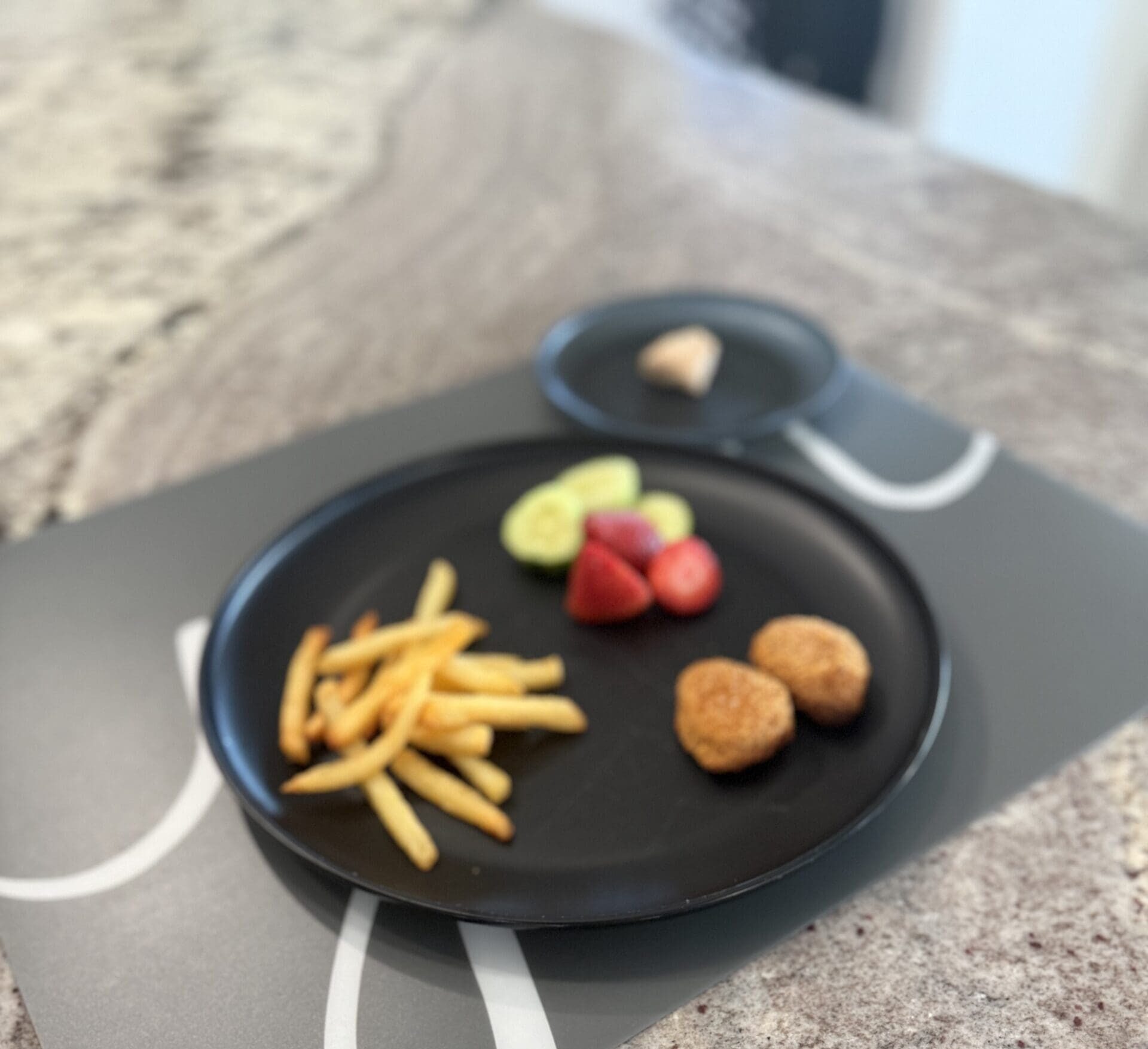
Fruit or vegetables are our biggest wild card. Fruit usually wins. Cooked vegetables often end up untouched on a learning plate—and that’s okay. The important part is that they’re there, and we keep trying.
Because trying—not liking—is the goal.
Why Some Kids Gravitate Toward Crunchy Foods
Here’s something that fascinated me once I understood it.
Kids who gravitate toward dry, crunchy carbs are often drawn to predictability.
Every bite of a chip or toasted waffle is the same. Same texture. Same taste. Same expectation.
But a strawberry? Every bite is different. One might be sweet, the next tart, the next mushy. That unpredictability can feel overwhelming, especially for the texture-dependent or sensory-sensitive kids.
This isn’t stubbornness.
It’s their nervous system looking for control.
And once you see it that way, the frustration softens a little—and patience becomes easier to find.
It’s also a reminder that picky eating isn’t solved with willpower or bribing. There’s real psychology behind what’s happening.
Rethinking Rewards
We all know the phrase:
“If you eat your vegetables, you can have dessert.”
But what that teaches, unintentionally, is that vegetables are the bad guy and dessert is the hero.
So instead, we shifted our approach.
In our home, trying new foods—whether they like them or not—earns a dollar in the family jar. After a certain amount of time or savings, we use that money for experiences together: adventure days, small trips, things that matter to all of us.
This does a few important things.
It removes pressure to like a food.
It encourages trying, over and over again.
And it connects food to real life—because the truth is, traveling and experiencing the world is a lot easier when we can eat a variety of foods.
Taco night was our biggest win with this.
Since eating tacos was going well for everyone in our house, I started casually suggesting we try Chipotle some night. No pressure. No timeline. Just curiosity. (And patience, waiting for them to ask me for the take-out night– because when it is their idea, it becomes more powerful.)
And they eventually did.
Now my pickiest eater begs for Chipotle on taco Tuesdays! We still get to try new things as we experiment with different sides– last week it was brown rice.
And, of course, they’re proud to keep contributing to the jar, knowing it leads to something bigger. (Josh, if you are reading this, I want to go to Disney World again…)
Zero pressure is key.
Casual suggestion is best.
Consistency is the magic.
The Baby Steps Still Matter
We already talked about how the progress with food is slow. Really slow. Painfully slow.
But it isn’t just the timeline itself– it’s the actual, physical steps of progress that can be so microscopic to the eye, you can easily miss them.
The difference can be looking at the untouched food– they can go from avoiding eye contact with the cauliflower, to spending a minute looking at it the next time. This is progress.
If at the first, they push the food around with their fork, but then they use their bare finger– this touch is a step in the right direction (it means they are willing to explore the texture).
They smell the food. They touch it to their lips without opening their mouth. Then a tiny little peak of the tongue to lick it.
Eventually tasting it.
Each step counts. And remember- what might feel like a step to you, is climbing a mountain to them.
One thing that helped us was using a learning plate—a small separate plate for new or challenging foods. It gives kids space to explore without pressure and helps their brains process what’s new.
If you haven’t caught on, another thing that helped was theming dinners for the week—Taco Tuesday, Breakfast for Dinner, Pizza Fridays. It created consistency while still allowing variation so we could keep celebrating the tiny little wins we would notice. (It also prevents what’s called a food jag, where kids burn out on a favorite food from overexposure in the exact same presentation.)
Even with doing all these “right” things, some nights the best thing you can do is tag your partner in, step away, and breathe. This process is physically and emotionally slow—for kids and for us.
It’s ok to say you need a break.
Where Organization Changes Everything
We always end up back here, don’t we?
I am not a food therapist (although I’ve got experience taking my kid to one!). Nor am I a physician (also experience in talking in great lengths about food to one!).
But I am real good at maintaining order, designing systems that last, and creating organization that matters.
And this is what has made all the difference in working through picky eating, a sustainable and successful process for our family.
Organization of our food, start to finish.
Grocery shopping isn’t something I squeeze in anymore. It’s intentional. Because consistent exposure starts with consistent food in the house.
Preparing produce is standard and routine, every time. Washed, cut, and stored in clear containers. Berries, cucumbers, carrots, peppers—always ready to grab.
Placement of food in our pantry and fridge is mindful and behaviorally strategic.
Because if the foods I want my kids to eat aren’t ready and visible, how can I expect them to choose them?
We use a red light, green light system that gives kids independence and context without restriction.
This organization doesn’t just help my kids.
It helps me, too.
When we all feel organized, we are in this effort together.
What I Want You to Hear Most
I’ve gone through the tips and the tricks, the psychology of behavior change and the mindset, the importance of environment, the do’s and the don’t’s.
But here is what I want to leave with, what I want you to remember most:
If dinner feels hard in your house right now, you are not alone.
And you certainly are not failing.
We are parenting.
This process takes time. It takes patience. It takes more repetition than any of us wish it did.
But progress is happening—even when it feels invisible.
I’ve watched a kid who once dragged his feet to food therapy class now make his own lunches.
I’ve watched picky eaters get excited about our upcoming dinner plans.
I’ve watched grocery store chaos turn into kids writing down the food lists for me.
It happens slowly. Then suddenly.
So keep showing up.
Keep offering.
Keep the environment calm.
And most of all—give yourself grace.
You’re doing better than you think.
Because at the end of the day, this isn’t really about broccoli or tacos or who ate how many bites. It’s about the environment we create, the habits we shape, and the life our children grow into—one small, ordinary dinner at a time.


View comments
+ Leave a comment